On this page
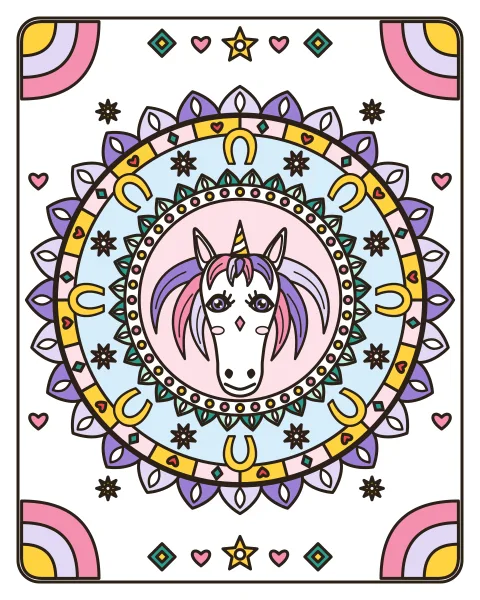
Round and round it goes, with a unicorn at the middle. This unicorn mandala coloring page has a front facing unicorn at its center, with her mane falling to both sides. Rings of beads and petals turn around her, along with horseshoes and stars, and an outer ring of hearts and diamonds leads to a border of leaf shaped petals.
It suits ages 7 and up, and many adults print it for a quiet evening. The shapes are clear and not too small. Give it 40 minutes to an hour.
How the rings are built
Starting at the center, the head sits on a plain disc, circled by a ring of 44 round beads. Next comes a ring of 32 petals, in two kinds that take turns. The wide band after that holds eight horseshoes and eight stars, spaced evenly like the numbers on a clock.
Beyond it, a thin band is split into 24 boxes, and each box holds a heart or a diamond. Then a ring of 28 pointed petals finishes the circle. The corners have curved bands in three layers, and there are stars, hearts and diamonds around the edge of the page.
Unicorn mandala coloring page color ideas
Mandalas look best when you limit your colors. Three or four is plenty. Try picking colors that sit near one another on a color wheel, such as purple with pink. Save one bright color, like yellow, for the stars and horseshoes.
- Sunset: orange with pink
- Ocean: teal with mint
- Candy: pink with pale blue
- Night: navy with gold
The two kinds of petals can take turns, one dark and one light. You will see a soft spinning effect as you go around. For the unicorn's mane, use the same colors as the rings so that she feels like part of the design.
Tips for staying relaxed
Work one ring at a time and finish it before starting the next. Turn the page as you go, so your hand always sits in the same easy spot. A lazy Susan or a plate under the page makes turning easy.
Choose your colors before you start and test them on a scrap. If you make a mistake, do not worry. Turn it into a pattern by doing the same thing at every horseshoe, and it will look planned.
Fine tip markers give crisp, bright results on thick paper. Colored pencils are quieter and easier to blend. Play soft music, sit somewhere with good light and try not to rush. There is no prize for finishing first.
Where the word mandala comes from
Mandala comes from Sanskrit, an old language of India, and it roughly means circle. Mandalas appear in Hinduism, Buddhism and Jainism. In one striking tradition, monks build detailed designs out of colored sand, then sweep them away, as a lesson that nothing lasts forever. The sand is then poured into running water. In the last century, the Swiss thinker Carl Jung helped bring the idea to the West. He noticed circles in art from many cultures, and he made circular drawings himself.
Try making your own
Draw a big circle with a plate, and a few smaller circles inside it. Split the rings with a ruler, like slices of a pie. Now pick one simple shape, such as a heart, and repeat it in every slice of a ring. It is much easier than it looks, and it teaches rotation.
Teachers can use this page in a math lesson. Ask how many times the design repeats, and how many degrees there are between one horseshoe and the next. Younger students can color only one quarter of the page, then pass it on to a friend to match.
More mandalas to print
The cat mandala coloring page uses the same ring idea with a different animal. The butterfly mandala coloring page is a lovely next step.
Questions
Where should I start on a mandala?
Most people start at the center and work out, because your hand does not rest on finished parts. If you are left handed, you may prefer to start at the outside.
Do the rings need to match all the way around?
No, but matching colors is what gives a mandala its calm look. Pick one color per ring, or use two colors that take turns.
Why are there horseshoes in the ring?
Horseshoes go with the horse theme, and they repeat well around a circle. There are eight of them, with eight stars between.