On this page
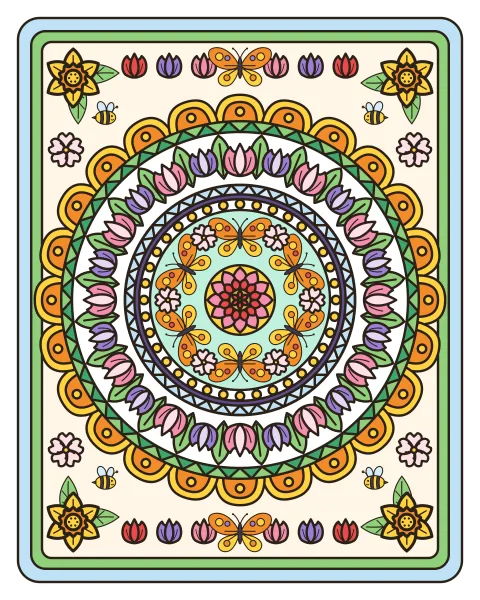
This butterfly mandala coloring page sets eight butterflies in a ring with their heads pointing out, so the whole circle seems ready to lift off. Each butterfly has two large upper wings with nested panels, two round lower wings with a target spot, and a pair of curled antennae. A slim leaf sits between each pair. Inside the ring, a round flower with two rows of petals fills the center, and a scalloped edge with 48 beads wraps the outside. Four petal tiles cover the rest of the page, with a flower in each corner.
It mixes a clear subject with the slow calm of a pattern. If plain mandalas feel a bit abstract, the butterflies give you something to aim for. The shapes suit teens and adults best, and patient kids of ten and up can color it over a few sessions.
Wing colors for a butterfly mandala coloring page
Pick a real butterfly or make one up. A monarch has orange wings with black veins and white dots, and that look works well here. Blue morpho butterflies have a bright sky blue shine. You could also use a rainbow fade from wing to wing.
Color all eight butterflies the same way, or alternate two kinds around the ring. That repeat is what makes it feel like a mandala. Keep the petals under the wings pale, so the butterflies stand out. The tiles around the circle can be two soft greens with yellow centers.
- Fade from dark to light toward the body.
- Finish the spots last, using your brightest colors.
- Add fine lines along the wings with a sharp pencil.
Symmetry in nature
A butterfly is a clear example of mirror symmetry. Each side of the body is a reflection of the other. Kids can test it with a small mirror held along the body on this page. The other half appears to stay in place. Many living things are built this way, including people. The butterfly article on Wikipedia shows how one changes from a caterpillar.
Try a paint test. Fold a sheet of paper in half and open it. Add blobs of paint to one side, then fold and press. Open it up to find a perfect mirror print that looks a lot like a butterfly.
Grow a butterfly garden
You can invite real butterflies to your yard or balcony. Plant flowers rich in nectar, such as lavender or zinnias. Monarchs lay their eggs on milkweed, so a few of those plants can help them too. Try not to use bug spray. A shallow dish with wet sand gives them a place to drink.
Keep a simple list of each kind you see. Children can draw them on the back of this sheet. That turns a summer afternoon into a small science project.
A relaxing project
For adults and teens, the wings are a good place to practice soft blending. Lay down a light color, add a darker one at the edge and go over the joint with a pale pencil. It takes a few tries, and it is very satisfying when it works.
A finished page makes a nice spring card. Cut out the circle and glue it on a folded sheet of colored paper.
Who can handle the tiles and beads
Kids from about ten can manage the upper wings and the large center petals. The tiles, beads and lower wing spots give teens and adults plenty of fine work.
Count the parts. With 8 butterflies you get 32 wings, and the outer rim holds 48 beads. Older students can work out that 8 butterflies around a ring sit 45 degrees apart. Then choose two colors and take turns filling the ring.
More spring patterns
After this butterfly mandala coloring page, try the butterfly page or the flower mandala page. Our spring coloring pages have more garden scenes, and you can see the full set on the mandala coloring pages hub.
Questions
Should both sides match?
For a true mandala look, yes. Matching wings make the design feel balanced.
Which butterfly should I copy?
Monarchs are orange with dark veins, and blue morphos are bright blue.
Can I print this for my class?
Yes. Print as many copies as you need for school, home or library use. Please do not sell the page.