
On this page
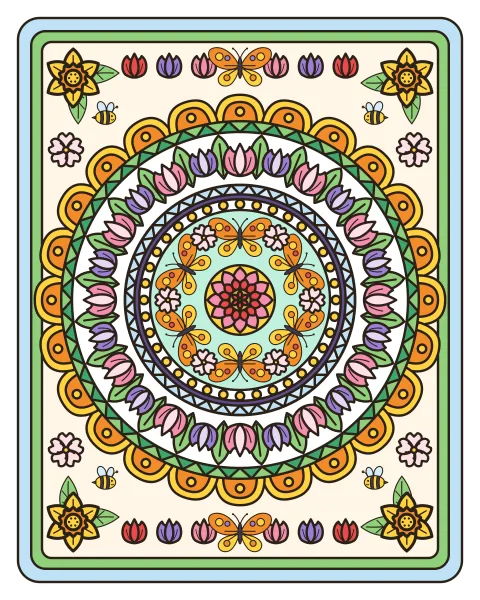
Every ring of this spring mandala coloring page holds something that wakes up after winter. A round flower sits at the center. Six butterflies and six blossoms take turns around it, followed by a band of tiny beads and a ring of triangles. The widest ring has 24 tulips, with long leaves tucked between them. Big scallops close the circle, and a border of daffodils, bees and small tulips fills out the rest of the sheet.
The design is meant for teens, adults and patient kids of about 10 and up. Plan on one or two hours, or take it one ring at a time. There are hundreds of small spaces here, so it is a good way to slow down at the end of a long day.
How the rings work
The tulip ring is really two sets of 12 flowers. One set is a little larger, and the other sits between them. That difference gives you a natural chance to use two colors in turn. If you look closely, each tulip has a second petal inside the first one, so you can use a darker and a lighter shade on a single bloom.
Outside the circle, each corner holds a daffodil with two leaves running along the edge. Six small tulips stand at the top with a butterfly among them, and the bottom row matches. Four bees and four blossoms float in the gaps. A double frame runs around the very edge of the page, and it makes a tidy place for a final bold color.
Spring mandala coloring page color ideas
A mandala rewards a plan. Choose four or five colors before you start and repeat them from the inside out. Try pink and purple tulips, gold scallops, deep green leaves and a mint center. That mix feels fresh, as if the whole page has just been rained on.
- Cool garden: blue, lilac and mint, with one yellow accent
- Warm sunrise: coral, peach, gold and cream
- Soft pastels: all colors pressed very lightly
- Bold stained glass: strong colors with a dark blue frame
Leave some white. Bright paper showing through in the bead ring or the triangles lets the eye rest, and the colors next to it look stronger.
Tips for smooth color
Test your palette first. Make a small row of dots on scrap paper, or color one tulip and its neighbor, and see how they sit together before you commit.
Turn the page as you go. It is much easier to fill a curved shape when your hand moves the way it wants to. Rotating the sheet also helps you keep all 24 tulips looking the same.
With colored pencils, use small circles rather than back and forth lines, and build up two thin layers. That gives an even finish with no streaks.
What a mandala is
The word mandala comes from Sanskrit, and it means circle. Mandalas have a long history in Hinduism and Buddhism, and they also appear in Jainism and Shinto. They reached modern Western thought largely through the psychologist Carl Jung. A page like this one borrows the circle shape for fun, so think of it as a garden laid out in rings.
Ways to use it
Make a season chart. Color this page in spring greens, then print a second copy and try summer colors, just to see how much the mood changes. Cut the finished circle out and glue it on a paper plate for a wall decoration. A group can also share one sheet, with each person taking a ring. It makes for a calm table activity at a spring brunch or a senior center.
More mandalas to color
The fall mandala coloring page uses the same kind of layout with maple leaves and acorns. For more petals, print the flower mandala coloring page. If the butterflies were your favorite ring, the butterfly mandala coloring page is the one to try.
Questions
How long will this mandala take?
Most people need an hour or two. You can do one ring at a sitting, which makes it a nice page to come back to through the week.
Should I color from the center out?
That is the usual way, since it keeps your hand off fresh color. Starting from the outer border also works if you plan to end on the flower in the middle.
Can a child color it?
Patient kids of about 10 and up can. Younger children may enjoy the outer scallops and the corner flowers, then leave the fine inner rings for later.


