On this page
No pastels and no blushing cheeks on this one. The realistic unicorn coloring page shows a powerful unicorn rearing up on a rocky cliff, front legs tucked, mane streaming down her neck. A full moon sits behind her head, and snowy peaks and a dark line of pines stretch out far below.
This page is for older kids, teens and adults. We drew her with true horse anatomy, so it rewards careful shading. Allow an hour if you want to do it justice.
Reading the horse's body
Horse artists learn the parts first, and it helps to know them here. The withers are the high point above the shoulders, where a horse's height is measured. On the front leg, the big joint we call the knee matches your wrist. On the back leg, the hock matches your ankle and heel. The fetlock, often called the ankle, sits above the hoof, and the pastern joins it to the hoof.
Now look at the drawing. You can find all of those on her legs. Thin lines mark the big shoulder muscle, the ribs along her barrel and the thigh. Those lines are guides for your shading, so keep them in mind as you color.
Realistic unicorn coloring page color ideas
Start with a real horse color. Dapple gray is a favorite for unicorns, with a coat of soft gray and a slightly darker mane. Cream looks elegant under moonlight. A dark bay with a black mane and tail would be a striking change.
- Cream moon with gray craters
- Lilac and blue gray mountains
- Deep teal hill with dark pines
- Warm gray rock with brown in the cracks
Keep the horn pale. Ivory with a little gray in the spiral grooves will look like real bone. Dark hooves anchor her to the rock.
Shading tips for older artists
Choose a light direction and stick to it. Here the moon is behind and to the right, so the edges nearest the moon can be bright and the side facing you can be a bit darker. Soft graphite or a gray pencil is a good place to begin. Lay in the darks, then add color over the top.
Shade in the direction that the hair grows. On a horse, that means from the head toward the tail along the body, and down the legs. Small curved strokes around the shoulder help show the round form of the muscle underneath.
For the mane and tail, work from dark to light. Fill each lock with a mid tone, then pull a darker pencil along one side. Leave thin strips of paper showing for highlights. The rock can be rougher, so short broken strokes work well.
Real anatomy behind the fantasy
A horse has about 205 bones, according to this guide to equine anatomy. A horse is really moving on its tiptoes. The hoof wraps around the last bone of the leg, and it is often compared to the tip of a finger or toe. Underneath is a springy wedge called the frog, which helps with movement and blood flow on each stride. That is why our rearing unicorn looks so light on her back legs, even with all her weight pushing down.
Practice ideas for art class
Try a value study. Print two copies. Shade the first in pencil only, then color the second. Compare them and see how much of the drawing's strength comes from light and dark alone.
Students who love horses can label ten body parts around the edge of the page, using arrows and neat writing. It makes a great science and art crossover. You can also ask students to look up a photo of a rearing horse and note what is the same and what is different.
More for older artists
The zentangle unicorn coloring page offers a totally different kind of challenge. If you want more shading practice, go to the unicorn portrait coloring page.
Questions
What makes this unicorn realistic?
The body follows a real horse: a long sloped shoulder, a deep chest, strong hind quarters and thin lower legs with true joints. The only made up part is the horn.
What color should a realistic unicorn be?
Think of real horse coats. Gray, cream, bay brown and black all look great. A soft gray with a darker mane is a good start.
Is this too hard for a young child?
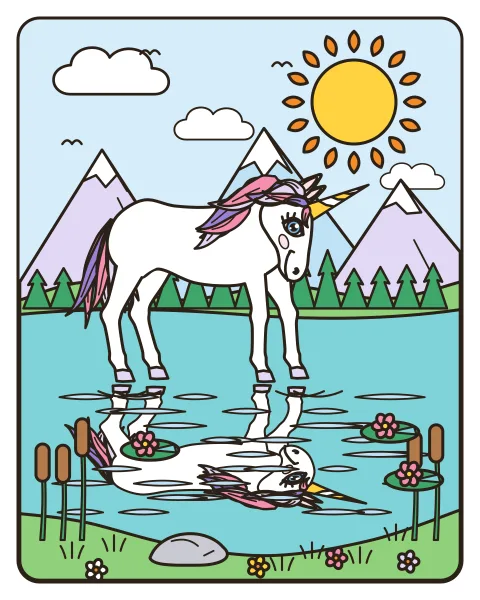
It is meant for older kids, about 9 and up. For a younger child, the unicorn by a lake or the garden page will be more fun.