On this page
- Baby animals, rain boots and more
- Spring coloring pages for each age
- Colors that feel like spring
- Printing on the right paper
- Lessons for the spring classroom
- Why the seasons change
- Take your spring coloring pages outside
- Baby animal names to learn
- Grow a bean beside your page
- Coloring a wet spring day
- A slow page for a spring evening
- More pages for the season
Baby animals, rain boots and more
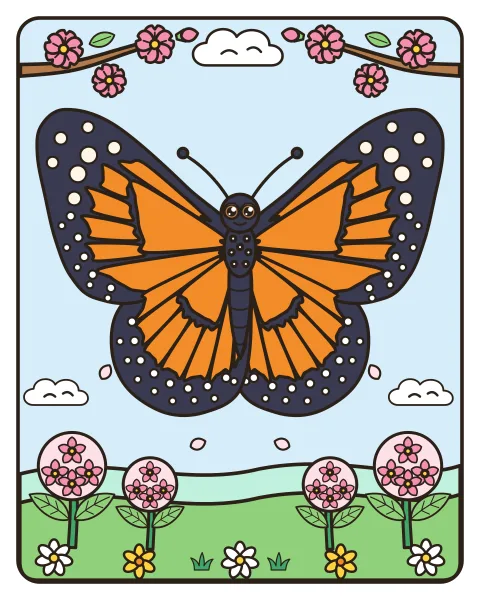
The cute group is the place to start, with baby animals on a farm, a pair of rain boots with a frog peeking out, and a child under an umbrella in the rain. The flower group has a field of tulips by a windmill and a monarch butterfly among the blossoms.
For a bigger scene, try the spring meadow or the spring cottage with its thatched roof. A bird nest full of hungry chicks is a good one for a lesson on life cycles.
Spring coloring pages for each age
- Ages 3 to 5: Try the kawaii spring page or the ladybug. Both have big shapes.
- Ages 5 to 8: The kite and planting seeds pages have a few small extras to finish.
- Ages 8 to 12: The garden and the robin on a branch have more to plan.
- Teens and adults: The cherry blossom page and the spring mandala take the most time.
Colors that feel like spring
Go pale. Soft shades work best for this time of year. Soft blue skies, fresh green grass and light pink blossoms all look right on the page. Save the strong colors for small spots, like a red ladybug or an orange beak.
- Use two greens on grass, a dark one close up and a light one far away.
- Try crayons and thin watercolor paint together for a rainy day sky.
- Color pale parts first, since dark colors can smudge onto them.
- Leave a few white spots on water to make it shine.
Printing on the right paper
Open any page and press Download PDF. The files fit US Letter paper, and they print well on A4 when you choose Fit to page. For crayons and pencils, plain paper is fine. For markers or paint, use card stock so that the color does not bleed through. You can also press Color and fill the page on a phone or tablet, which is handy in a waiting room.
Lessons for the spring classroom
Spring is a busy time for science in many schools, and these pages fit right in. The ladybug goes well with a unit on insects, while the garden pairs with planting seeds in a paper cup. Use the rain boots for a weather chart, and hang them next to a record of each day's rain.
The bird and the duck both support lessons on life cycles and baby animals. A kite can start a talk about wind and forces, or a math lesson on shapes. School copies are fine, and our free use license explains the details.
Parents can use them at home too. A short coloring break after school gives kids time to settle down before homework. It also gets them talking about what they saw on the walk home, like a robin on a fence or a puddle worth jumping in.
Why the seasons change
Spring comes because the Earth is tilted as it travels around the sun. As the northern half tips toward the sun, the days get longer and the ground warms up. Plants wake, birds build nests and many baby animals are born. In the Northern Hemisphere, the first day of spring comes around March 20, including in 2027. You can read more about spring on Wikipedia.
That first day is called the equinox. Day and night are nearly equal in length then, all over the world. Kids can test this by marking sunset time on a calendar for a few weeks and watching it get later.
Take your spring coloring pages outside
Take your colored pages on a walk. Bring the ladybug and the bird, and see if you can spot the real thing. Kids can put a small check mark on the sheet each time they find one. Add a few more items to the list, such as a worm, a new leaf or a robin's egg shell.
Start a nature journal, too. Staple a few blank sheets behind a colored page to make a small book. Each week, your child can draw one new thing that has changed outside. By May, you will have a neat record of the whole season, and the first drawing of bare trees will look very different.
On rainy days, a craft works just as well. Cut out the kite, tape on a ribbon tail and hang it from the ceiling above a desk. It moves when you walk past. Kids love that.
Baby animal names to learn
The baby animals page is a ready made word lesson. Nine babies stand by a red barn, and most have a name of their own. Point to one, say the name and ask what it grows up to be.
- A fawn grows into a deer. Keep its spots pale, since they help it hide among the leaves.
- A lamb grows into a sheep. Cream or light gray wool looks softer than plain white.
- A piglet grows into a pig, and a pale pink suits it well.
- A duckling grows into a duck. Compare it with the three on the duck page.
- A chick grows into a hen or a rooster.
Baby rabbits are called kits, which surprises plenty of grown ups too. The bird nest page adds some easy math. Three chicks and two blue eggs sit in the nest, so how many babies will the mother robin have to feed once the eggs hatch?
Grow a bean beside your page
The planting seeds page shows five numbered steps from seed to sunflower, right there in the soil. You can watch the same thing happen at home. Fold a wet paper towel around a dry bean, slide it into a clear zip bag and tape the bag to a sunny window. Keep the towel damp and check it each morning.
A root comes first. The shoot follows. When something changes, ask your child which numbered step it matches and put a small sticker next to that step on the page. The worm and the mole in the soil are good for a talk about what lives under our feet.
Coloring a wet spring day
Two pages here are all about rain, the rain boots and the umbrella in the rain. Color the sky a soft blue gray, and the page stays cheerful instead of gloomy. Then let the boots or the raincoat take the loudest color in the box. Yellow is the classic pick. The frog peeking out of the boot can be a strong green, with no competition.
Puddles are the fun part. Color the water pale blue, then add a few wavy lines of the boot color just under the boot. That small wobble reads as a reflection. For rain, draw short blue lines that all slant the same way.
A slow page for a spring evening
The cherry blossom page is the big one in this set, with a koi pond, a red arched bridge and a stone lantern under the tree. Keep most of the petals pale and put a slightly darker pink in the heart of each bloom. Let the bridge be the one strong red, and give the koi orange patches. If you want a fact to share, Japan gave Washington, D.C., its famous cherry trees in 1912.
More pages for the season
When spring holidays come around, see our Easter coloring pages for bunnies and eggs. Gardeners will also like our flower coloring pages, and the animal coloring pages have more friends for young kids. Our preschool coloring pages are a good next stop for the smallest artists.
Questions
Are these spring coloring pages free?
Yes. All of them are free to print or color online for home, classroom and library use.
Can I download all the spring coloring pages at once?
Yes. Press Download all at the top of the page to get every drawing in one PDF, with one drawing on each sheet.
Which spring page is best for a toddler?
The ladybug is best. It has big round shapes and few small parts.
Can I use these pages for a science lesson?
Yes. They fit units on insects, weather, life cycles and plants.
Do these pages print on A4 paper?
Yes. Choose Fit to page in your print settings.