

On this page
Pick your mission
Young kids should start with the rocket coloring page, which has one big ship and a happy face in the window. The alien coloring page is just as easy, and the little visitor is friendly, not scary. Anyone who dreams of floating among the stars will like the astronaut coloring page.
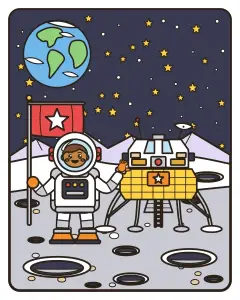
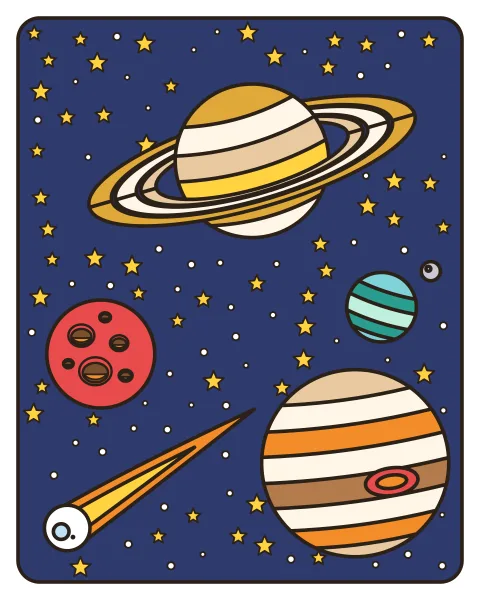
Older kids can try the planets coloring page, where stripes and rings are good for blending. The moon landing coloring page has more small parts, so it takes longer. For a real learning sheet, print the solar system coloring page. It names all eight planets in order.
Space coloring pages by age
Children of three to five do best with one large shape. A rocket or an alien gives them a clear job, and they can finish before they get tired. Sit with them and name the parts as they go. Nose, fin, window and flame are all fun new words.
Kids of six to nine are ready for scenes with more going on. They often want to add their own stars or give a planet a silly name. Let them. Those extra touches are where the real creative thinking happens.
Tweens and teens can treat these sheets as a small art project. Colored pencils work well for soft shadows on a round planet, and a dark sky makes bright colors look even stronger.
Colors that make the sky look deep
Dark blue or purple is the best choice for outer space. Use the side of a crayon, press lightly and go over the area twice. If you color in small circles, the sky looks smooth and you see fewer stripes. Leave each star white or yellow until the end.
Try printing on black paper for something new. Gel pens and metal markers show up well on dark sheets, and the whole picture seems to glow. Plain crayons will not show up well, so test one in a corner first.
Real facts to share
Space is full of big numbers, and kids love them. Sunlight takes about eight minutes to reach Earth. Jupiter is so wide that more than a thousand Earths could fit inside it. Twelve people have walked on the Moon, and their footprints are still there, since no wind blows them away.
The first person in space was Yuri Gagarin, who flew in 1961. Today, crews live on the International Space Station and circle our planet about every 90 minutes. You can find photos and games for kids on the NASA kids and students page.
Space ideas for teachers and parents
Teachers can build a whole unit around these sheets. Start with the solar system page, then give each group one planet to study. Each team writes three facts on a card and pins it beside the colored picture. By the end of the week, you will have a full wall display.
At home, make a space corner. Hang the finished pages by a bed, add a few glow stars to the ceiling and read a library book about the Moon. Clear nights are a good time to step outside and look up, and you do not need a telescope to spot the Moon or a bright planet.
Birthday parties work well too. Set a page and a few crayons at each seat as guests arrive. Print the astronaut sheet, cut out a hole for the face and you have a quick photo prop.
Space words to learn
These pages can also build vocabulary. Orbit. Crater. Comet. Gravity. Try one new word on each sheet. An orbit is the path one object takes around another, and a crater is a bowl shaped hole made when a rock hits the ground. Write the word under the picture, then ask your child to use it in a sentence. Keep the finished sheets in a folder, and by the end of the month you will have a small space book.
A sentence to remember the planets
The solar system page labels the planets in order, and kids can learn that order with one silly sentence: My Very Excellent Mother Just Served Us Noodles. Each first letter stands for a planet, going out from the Sun. That gives you Mercury, Venus, Earth, Mars, Jupiter, Saturn, Uranus and Neptune. Read the sentence while your child taps each planet, then cover the labels and try it again.
Someone will ask about Pluto. It was called a planet for many years until scientists moved it to the group known as dwarf planets in 2006. Once the order sticks, let your child make up a new sentence of their own. A goofy one is often the easiest to remember. For our home planet, print the smiling Earth on its own sheet, with the Moon nearby.
Design a pet for the alien
The alien page has a tiny pet, and it leaves a lot of questions. Does it eat rocks? Does it need a walk in low gravity? Ask your child to invent a new pet on the back of the sheet, then think about the planet it comes from. A cold world might need a furry animal. A world with thick air might need big wings. Your child is working out how living things fit a place, and all it looks like is a silly drawing.
Detailed pages for big kids
Older kids may want more than a rocket with a face. The astronaut on the moon bounds across a cratered plain in low gravity, with Earth hanging huge in the black sky behind. The space battle ship is a long armored starship flying through cratered asteroids, with its engines blazing and a ringed planet ahead. Both suit ages eight and up. Color the bright engines and planets first, then bring the dark sky up around them.
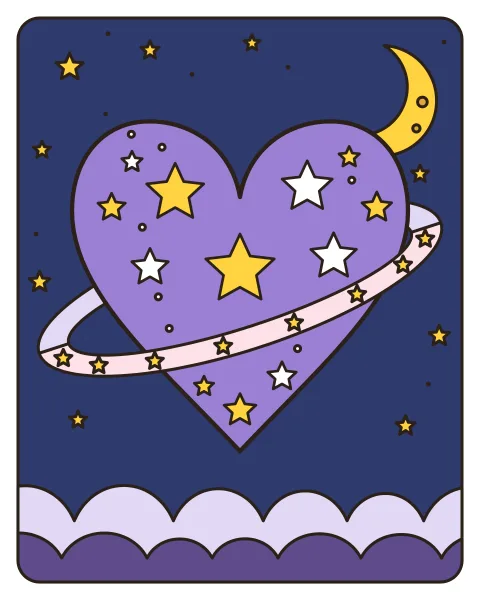
The round designs are a different kind of slow. The galaxy mandala has a six arm spiral with an orbit of planets. The moon mandala puts a full moon inside a ring of twelve crescents and stars. A year has about twelve full moons, so your child can color one crescent each month. For a space fan on Valentine's Day, try the heart with stars, which wears a ring like a planet.
Watch the Moon change
The rim of the galaxy mandala shows the phases of the Moon, and that makes a nice home project. Step outside on clear evenings for two weeks and sketch the shape you see on a calendar. Your child will watch it grow or shrink a little each night. The Moon does not really change shape, of course. We just see a different amount of its sunlit side.
How to print
Open any page and press Download PDF. The file fits US Letter paper, and it prints on A4 if you choose Fit to page. Plain printer paper is fine for crayons. For markers, use thicker paper so the ink does not bleed through. All of our pages are free for home, classroom and library use, as you can see in our free use license.
More to explore
Looking for something else? Our Earth Day coloring pages stay a little closer to home, and our dinosaur coloring pages go far back in time. You can also browse all coloring pages to find a new favorite.
Questions
Are these space coloring pages free?
Yes. All of them are free to print or color online for home, classroom and library use.
Which page is best for a preschooler?
The rocket and the alien are best. Both have large shapes and thick lines.
Do you have a page with the planet names?
Yes. The solar system page labels all eight planets in order from the Sun.
What color should I use for the sky?
Dark blue or purple works well. Color lightly and go over it twice for a smooth look.