
On this page
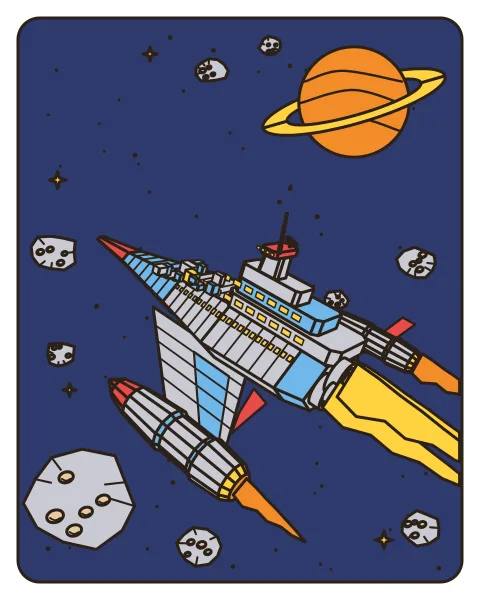
This space battle ship coloring page shows a long armored starship pushing through a field of tumbling asteroids. The pointed bow aims up toward the left, the engines blaze at the lower right, and the whole hull makes one strong line across the sheet. There is no fighting at all. The danger comes from the rocks, and the only fire in sight is coming from the ship's own engines.
The ship is an original design, and it is packed with small parts. That makes it a great long project for anyone who loves building model kits. Allow an hour or more.
Tour of the ship
Start at the sharp nose and work back. Panel lines run across the hull, and a row of small windows follows the side like a string of lights. Near the bow you will spot clusters of tiny blocks, the kind of machinery that makes a big ship look real. Stacked decks rise from the middle, each smaller than the last, and rows of larger windows line their sides.
At the very top sits a bridge with a tall antenna and a small dish. Two swept wings spread from the hull, each with a blue panel and a red fin. At the end of each wing hangs a long engine pod, ribbed like a barrel, with a red tip at the front.
Behind the ship is a big orange planet with a ring that passes behind and in front of it. Asteroids of all sizes drift past, each marked with craters. Stars fill whatever is left.
Space battle ship coloring page color schemes
Big ships look huge when their colors stay quiet. Use a pale gray or off white for most of the hull, then add small hits of strong color on the fins, nose and stripes. If everything is bright, the ship will look like a toy.
- Fleet gray: light gray hull, blue panels and red markings.
- Deep explorer: white hull with orange trim, in the style of real space hardware.
- Night hauler: dark navy hull with hundreds of tiny yellow windows.
- Old freighter: rust brown and faded green, with patches on the armor.
The jets are your brightest spot. Go nearly white right at the nozzle, then yellow, then orange at the tip. Windows look great in pale yellow, and they read even better on a darker hull.
Showing size in space
Space has no air, so far objects do not really fade. Artists often fade them anyway, because the eye reads pale things as distant. Keep the small rocks paler than the big rock near the corner. Let the large one be your darkest and most detailed asteroid.
Pick a sun. If the light falls from the upper right, every asteroid gets a bright edge there and a dark side at the lower left. Do the same on the ship, with light on the top decks and shadow under the wings. Use the planet's stripes as a chance to blend orange, cream and brown.
A white gel pen is handy here. Add tiny stars, or a thin bright edge to the ring, after the dark sky is done.
Real asteroid facts
Asteroids are rocky leftovers from when our solar system formed, about 4.6 billion years ago. Most orbit the Sun between Mars and Jupiter, in the main asteroid belt. That belt holds an estimated 1.1 to 1.9 million asteroids wider than 1 kilometer, plus millions of smaller ones.
Most are lumpy instead of round, many are covered in craters, and they spin as they travel, sometimes tumbling end over end. The largest, Vesta, is about 329 miles across. NASA keeps more on its asteroid facts page.
Crew up
Write the ship's log. Give the vessel a name, a captain and a mission, then record what happens during the trip through this rock field. Did a stone scrape the hull? Which deck took the hit?
You can also draw a cutaway. On a blank page, sketch the side of the ship and mark where the crew sleep, eat and work. It is a fun way to think about how people would really live out there.
For more space art, try the planets coloring page or the solar system coloring page.
Questions
Is there any fighting in this picture?
No. The ship is simply flying through an asteroid field. There are no weapons firing and nobody to fight.
Is this ship from a movie or game?
No. It is an original design, so you are free to name it and choose its colors.
How do I make the space background dark enough?
Use a dark blue or black pencil on its side with firm pressure, and color around the stars. Two thin layers cover better than one thick one.


