On this page
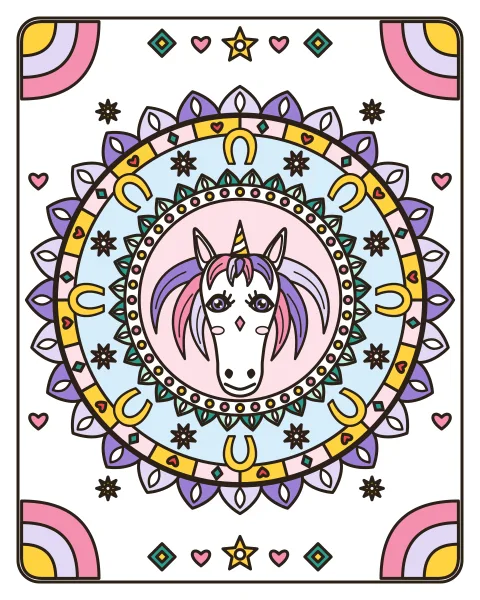
These mandala coloring sheets give you five round designs on one page. A petal mandala, a star, a lattice, a heart ring and a spinning sun all sit on a diamond grid, so you can change your mood from circle to circle. Small star medallions fill the gaps, and curved bands fill the four corners. The shapes are medium sized, so you can finish one circle in a sitting or do one a day.
Nothing here demands a plan. You start at the middle of any circle, pick a color and move out one shape at a time. That simple rhythm is why people return to mandalas again and again.
How to choose colors for mandala coloring sheets
A limited palette gives the best result. Pick three or four colors that sit next to each other on the color wheel, such as pink, orange and yellow. Add one cool color, like teal, as an accent. Each ring should use the same color all the way around, which keeps the design balanced.
Work from the center out, so your hand does not rub the finished parts. Light colors first, then dark. If you make a choice you do not like, go over it with a darker shade. A mandala has no mistakes, only a new ring.
- Test your colors on a scrap of paper before you start.
- Use a sharp pencil for the smallest petals.
- Rotate the page so your hand stays comfortable.
What is a mandala?
The word mandala comes from Sanskrit, and it means circle. In Hindu and Buddhist traditions, these designs are used as a tool for prayer and focus. Tibetan monks make detailed sand mandalas over many days, then sweep them away to show that nothing lasts forever. The psychologist Carl Jung later drew them as a way to look at his own thoughts. Wikipedia has a longer entry on the mandala.
Modern coloring books brought the idea into homes all over the world. They are a simple form of quiet time that anyone can try.
Why coloring can feel calming
Repeating the same small action gives the mind one easy job. Some studies suggest that a short session of coloring a detailed pattern may help lower stress for a while. It is not a cure for anything, but plenty of people find it a pleasant break. Try it for ten minutes instead of looking at a phone. Sit by a window, and notice your breathing as you work.
Teachers often use mandalas for a calm start after lunch. Older students can color while listening to a story or quiet music, and the room settles quickly.
Good uses for a finished page
A colored mandala makes a nice card. Cut out the circle, glue it to folded card stock and write a note inside. You could also frame a few together in a row. On thin paper, a dab of oil on the back turns it into a window decoration, and the light will shine through.
Print it well
Use thicker paper for markers and plain paper for colored pencils. Print at full size so the small shapes stay easy to color.
Take a photo halfway, then another at the end. Seeing how the page grew, one ring at a time, is oddly rewarding. Share it, or keep it private.
If you are coloring with a child, let them choose the first color and then take turns choosing the next one for each ring. You end up with a page that neither of you would have planned alone, and the turns keep a restless child at the table longer than you might expect.
More round patterns
If you enjoy these mandala coloring sheets, try the mandala art page or the lotus mandala page. Beginners may like the easy mandala page. You will find many more on our mandala coloring pages hub.
Questions
Where should I start coloring?
Start at the center and work outward, so your hand does not smudge finished rings.
How many colors do I need?
Three or four colors plus one accent is plenty.
Can I print this for my class?
Yes. Print as many copies as you need for school, home or library use. Please do not sell the page.