On this page
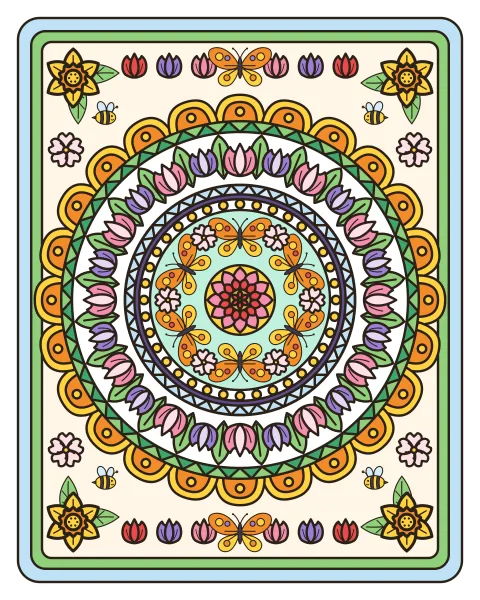
This mandala art coloring page has a bold, geometric style. Twenty rhombus shapes spin out from a small flower and grow row by row into squares, then into wide diamonds, so the whole circle looks like a woven dome. A ring of thirty pointed triangles surrounds it, each one holding a slim leaf. Triangle tiles cover the background, and a striped fan opens from each corner.
The straight edges and sharp points give it the feel of a stained glass window. If you like neat, crisp work, this is the sheet for you.
Plan your mandala art coloring page
Strong contrast suits this design. Try deep blue and teal for the large shapes, then use gold or yellow for the small accents. Keep at least one ring pale, so the eye has a place to rest. A white ring between dark ones makes both sides look brighter.
For a stained glass effect, use markers or colored pencils pressed firmly. Leave the black lines clean, since they act like the lead between pieces of glass. Rich jewel colors such as ruby, emerald and sapphire look great here.
- Color all the shapes of one type before you switch pencils.
- Keep your pencil sharp for crisp points.
- Add soft shading toward the center of each diamond.
The math behind the pattern
A mandala is really a lesson in symmetry. This design has radial symmetry, which means it looks the same when you turn it by a certain angle. The center flower repeats ten times, the rhombus rows twenty times and the outer ring thirty times. Artists in many parts of the world have used such patterns for centuries, from the tile work of Islamic palaces to the rose windows of Gothic churches. You can read about rotational symmetry on Wikipedia.
Students can find these numbers by counting. Then ask them to work out the angle between each repeat. Divide 360 by twenty, and you have 18 degrees. Art and math teachers can happily share this one.
Try your own mandala
You can draw a simple version with a pencil and a plate. Trace the plate, then fold the paper in half three times to make eight equal sections. Open it up, and draw a shape in one section. Copy that shape in each of the others. A protractor helps, but it is not needed for a first try.
Keep a light hand so that you can erase the guide lines at the end. The result feels very satisfying, and every person's design turns out differently.
A slow craft for busy days
This is not a page to rush. Set aside an hour, or split it over a few evenings. Many adults like to keep one on the coffee table with a pack of good pencils. Put your phone in another room. You will be surprised at how fast the time goes.
If you get tired of one color, swap to a new one in the next ring. The design can hold a lot of variety. The wide diamonds near the edge of the star take color well, so they are a good place to try a soft fade.
Small shapes for teens and adults
Teens and adults get the most from this sheet, as the shapes are small. Older children can try it with fine tip markers. Younger kids may do better with the easy mandala page.
Change one rule. Use only warm colors in the inner rows, and only cool ones in the outer rows. Limits like that can make a project far more interesting.
More detailed patterns
Once your mandala art coloring page is done, try the detailed mandala page or the geometric page. Our coloring pages for adults offer more quiet projects, and you can see every design on the mandala coloring pages hub.
Questions
Is this mandala hard?
The shapes are small, so it suits teens, adults and patient older kids.
How do I get a stained glass look?
Use rich jewel colors, press firmly and keep the black lines clean.
Can I print this for my class?
Yes. Print as many copies as you need for school, home or library use. Please do not sell the page.