
On this page
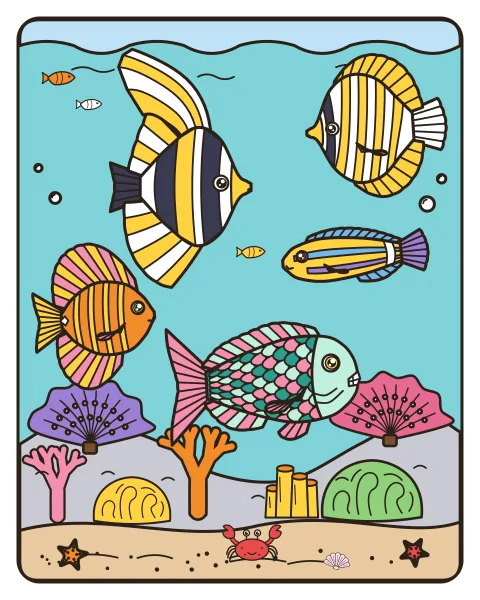
Five very different fish share one busy reef in this drawing. The tropical fish coloring page has a tall fish with a long banner on its back, a round yellow butterflyfish, a slim striped wrasse, a disc shaped tang and a big scaled parrotfish with a little beak. Fan corals, brain corals and branching corals cover the rocks below. A red crab and two starfish rest on the sand.
We rate it as detailed, so it fits kids from about 7 to 14. Give it 45 minutes or more. Because each fish has its own shape, the page never feels like doing the same thing over and over.
Five shapes to compare
Start by asking your child to point out what makes each fish different. The butterflyfish has a thin round body and a pointed snout. The banner fish carries a long sweeping fin high over its back. The wrasse is long and narrow, with stripes that run from head to tail. The tang has wide fins above and below that make it look like a sail. The parrotfish is the heavy one, with rows of closed scales and white teeth at the front of its mouth.
Stripes go up and down on some fish and sideways on others. That is a good thing to notice before you pick colors.
Tropical fish coloring page color ideas
Reef fish can wear loud colors, so there is no wrong answer. Give each fish its own main color, so they stand apart. Here is one plan that works:
- Butterflyfish in yellow and white with a dark eye band
- Banner fish in black, white and yellow bars
- Wrasse in yellow with blue and purple stripes
- Tang in orange with a pink and yellow sail
- Parrotfish in teal, mint and pink
Then choose the reef so it does not fight with the fish. Purple and pink fans sit nicely behind yellow and orange. Keep the rocks gray and the water a soft blue green, which gives the eye a place to rest.
Tips for a busy page
Do the fish first, one at a time. When all five are finished, you can see which corals need a color that helps and which need a quiet one.
Try to use each bright color on two parts of the page. A pink tail on the parrotfish looks better if a pink fan coral sits nearby. Small repeats like that tie the whole picture together.
For the scales, pick three shades and rotate them in order. This looks rich, and it is far faster than making a new choice for every scale. Colored pencils or fine markers suit this page better than crayons.
Fish facts from the reef
The butterflyfish is among the most common sights on reefs around the world, and there are at least 114 species. Most have detailed patterns on blue, red, orange or yellow, and many have a dark band across the eye, as ours does. They spend their days pecking at coral and rock with long thin snouts, looking for coral polyps, worms and other small animals. Some swim in small schools, while many stay alone until they find a partner.
Activities for home and school
Play a quick game of I Spy with the finished page. Ask for a fish with a long banner, an animal with claws, a creature with five arms and a coral that looks like a fan. Younger kids can count the bubbles and the tiny fish.
Students can also invent a new reef fish. Have them take the body of one fish and the fins of another, draw it on the back of the sheet and write a name and one sentence about where it hides. A small library book on coral reefs makes a nice partner for this lesson.
More pages to explore
Meet two reef neighbors up close on the clownfish coloring page. The sea turtle coloring page and the school of fish coloring page are also good next picks.
Questions
How many kinds of fish are on this page?
Five large fish, each a different shape, plus three tiny ones. Kids can look them up and match real colors, or invent their own.
Can a whole class share this sheet?
Yes. It works well as a group job. Give each student one fish to color on a large copy, then put the finished reef on the wall.
Is it too hard for a 7-year-old?
The scaled fish near the bottom is the hardest part. A 7-year-old can color the other fish first and treat its scales as one color.


