On this page
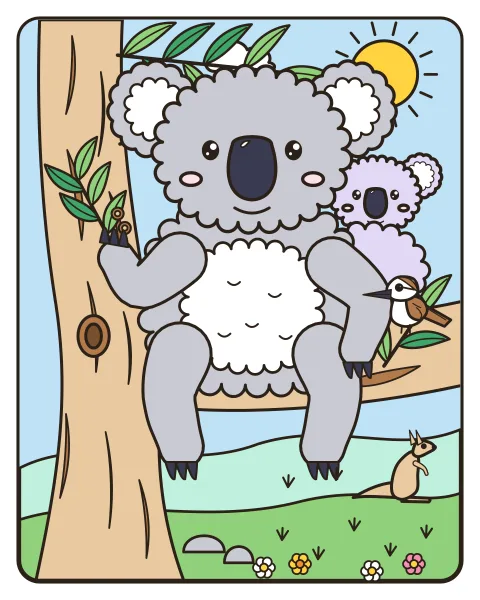
Big fluffy ears, a wide dark nose and a joey on her back make this koala coloring page very hard to resist. A mother koala sits on a thick gum tree branch with her legs hanging down and a twig of leaves in one paw. Her little one peeks over her shoulder. Look closely and you can find a kookaburra on the branch and a kangaroo down on the hill.
Kids from 4 to 10 will like it, and it takes about 25 minutes. The large shapes go fast, while the leaves and the bark marks ask for a little more care.
Koala colors that look real
Real koalas are soft gray. They have a white chest, and the fur inside each ear is pale and fluffy, which is why those ears look so huge in the wild. A light gray crayon is all you need for mom. Keep the joey one shade paler, so the two do not blend together where they touch.
That big nose should be the darkest thing on the page. Use black. Their small claws can be dark too.
The trunk is a pale tan with brown bark streaks, and there is a round knot halfway up. Gum leaves are a dull blue green, not a bright grass green, so try mixing a green with a little blue. Pale blue suits the sky, and the hills can go from mint to a stronger green as they get closer.
Getting that fluffy look
- Follow the bumpy outline with your pencil, using short strokes that point outward.
- Add a second, darker gray only at the edge of each ear and along her arms.
- Keep the chest white, then add the small curved fur marks with a light gray.
- Color the sky after the leaves, so the thin tips stay sharp.
Markers tend to look flat on fur. Crayons or colored pencils give a softer finish, and you can rub the gray gently with a tissue to blend it.
True koala facts
A koala is not a bear. It is a marsupial, which means the baby spends its first months growing inside a pouch on the mother's belly, much like a kangaroo. A newborn joey is about the size of a jelly bean. After around six months it starts to come out, and then it rides on mom's back, just as this one does. Britannica's koala page covers their life in the wild.
Koalas eat almost nothing but gum leaves, which have little energy in them. That is why they sleep for most of the day, often up to 18 hours or more.
Wild koalas live only in eastern and southern Australia. The kookaburra and the kangaroo in this picture are Australian animals too, so all three could really meet.
Something to do with your koala coloring page
Make a koala map. Find Australia on a globe or a tablet, then cut out the finished koala and tape it near the east coast. Young kids love knowing where an animal really lives.
You can also write a little story. What is the joey looking at? What does the kookaburra say to the kangaroo? Have your child draw a speech bubble on the page and give one animal a line to say.
For a classroom, this drawing fits a lesson on marsupials. Ask students to list what makes a koala different from a real bear, then pin their lists beside the art.
More animals to meet
Browse the rest of our animal coloring pages for a wider mix. If your child likes round fluffy faces, try the panda in a tree next. The zoo gate is a good pick when one animal is not enough.
Questions
What kind of tree is it?
It is a gum tree, the name Australians use for a eucalyptus. Those long thin leaves are what koalas eat.
What is the bird on the branch?
It is a kookaburra, an Australian bird known for a loud call that sounds like laughing.
Is the fur hard to color?
No. Fill it with light gray first, then add a few short strokes around the edges with a darker pencil.