On this page
This 4th of July parade coloring page puts three kids at the front of a small town march. A girl taps a snare drum, a boy carries a big American flag, and the smallest one blows a trumpet with both cheeks puffed. A dog in a star bandana trots along at the back as if the whole thing was his idea.
Behind them runs Main Street, with brick shops, striped awnings and a row of neighbors at the curb. Bunting hangs across the road from one roof to the other. There is a lot going on here, so we marked it as a detailed page for ages 6 to 12.
Where to begin on this 4th of July parade coloring page
Start with the three kids, since they are the biggest shapes and they set the mood. Give each one a matching band uniform, or let every child wear their own bright shirt. Then pick a side of the street and move along it one shop at a time. Short on time? Do the marchers today and save the street for tomorrow.
The crowd is the part most kids skip. Don't. Those small round heads are a fun place to add your own family. One house rule we like: find a face for Grandma, a face for the neighbor, and a face for the mail carrier.
Reds and blues that hold up in a crowd
A page with this many stars and stripes can turn into one big red and blue blur. The trick is to use those two colors only where they count. Keep them for the flag, the bunting and the drum rim, then choose warm browns and tans for the shops.
- Brick walls look great in a dull red brown with a few darker bricks.
- Try yellow and white on the awnings so they stand apart from the bunting.
- The sky can stay pale blue, or go white if your crayons are running low.
- Give the dog a brown patch over one eye. It makes him look like a real neighborhood pet.
Check the flag as you go. It has 13 stripes, and the top and bottom ones are red. That means seven red stripes and six white, one for each of the first 13 colonies. Kids love catching this kind of detail, so ask them to count before they color.
Why towns march on the Fourth
The Continental Congress approved the Declaration of Independence on July 4, 1776, in Philadelphia. Parades, picnics and fireworks grew up around that date, and they are still the ways most towns mark it today. You can read more in this Independence Day history.
Small town parades are often a real mix. You might see a high school band, a fire truck, kids on bikes and a tractor pulling a hay wagon, all in the same line.
Make your own march at home
Once the page is done, tape it to a paper towel tube and carry it like a banner. Pots make fine drums, and a kazoo counts as a trumpet in any home we know. March around the yard and let the dog join in, if the dog agrees.
In class, this page can start a short writing task. Ask each child to pick one person in the crowd and write two lines about what that person is cheering for. Teachers can also use the shops for a quick map lesson. Which shop comes first? Which one is across the street?
More red, white and blue pages
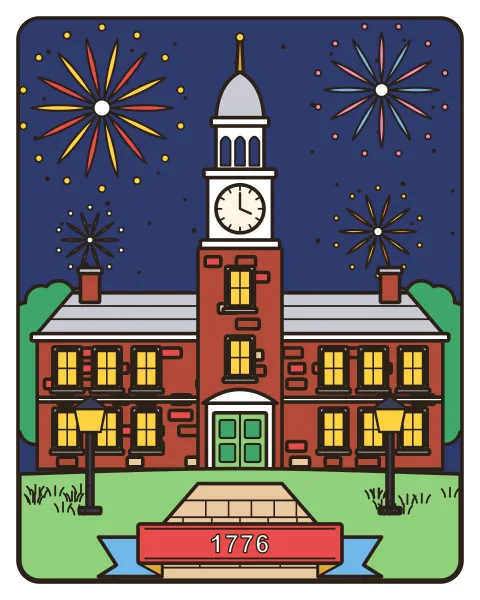
Pair the parade with our American flag page, then end the night with the fireworks over a small town. Every holiday drawing is in our 4th of July coloring pages.
Questions
How long does this page take?
Plan on 45 minutes or more. The shop fronts and the crowd hold a lot of small parts, so it works well over two sittings.
Does the flag have the right number of stripes?
Yes. It has 13 stripes, seven red and six white, with red at the top and the bottom.
Can younger kids color it?
A six year old can do the marchers and leave the shops for a grown up or an older sibling.